Evolving-world simulation · Evolving
Tiny Civilisation
Explore Tiny Civilisation, an evolving-world simulation where simple rules grow into complicated little societies.
Field observation
A small act of infrastructure
Observation / Stable-ish
Field station / delta 04
Field note 009: A bridge appeared overnight. Nobody remembers proposing it.
- Cycle
- 009
- Settlements
- 05
- Observation
- Unexpectedly civic
Open the observation with the browser's native disclosure control. The field note remains available by keyboard or touch and when JavaScript is unavailable.
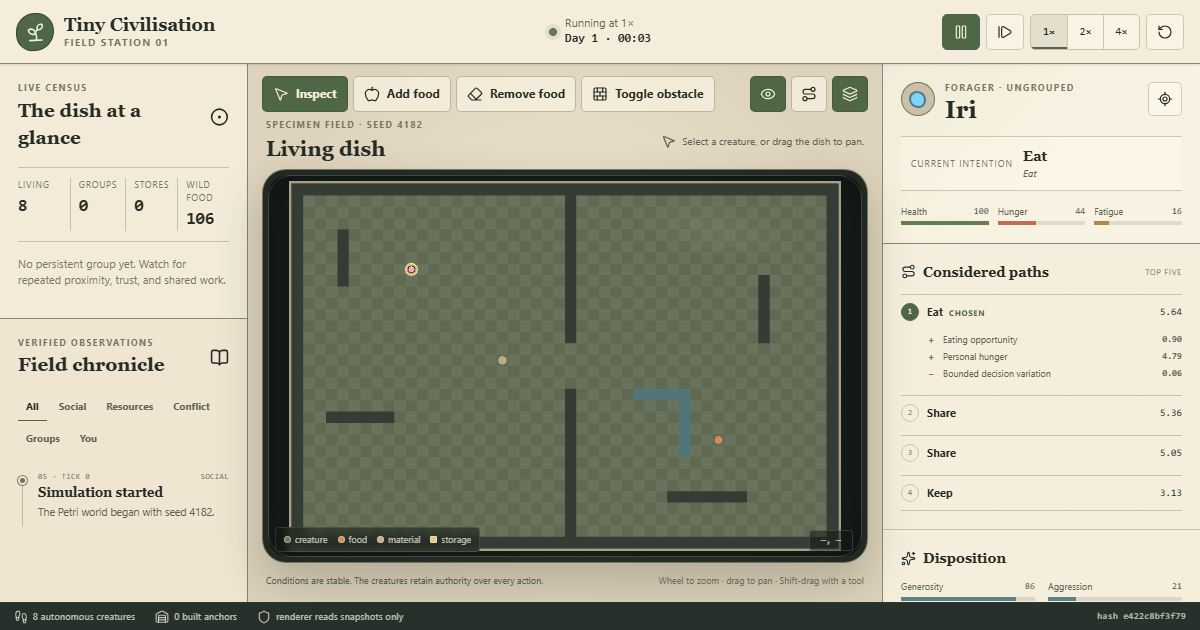
Simple rules, complicated societies
Tiny Civilisation is an observable social simulation in a Petri dish. The player changes resources and terrain while autonomous creatures decide how to respond; there are no movement or build orders that force a social outcome.
What you can do
Pause or play the simulation, advance one tick, inspect and follow a creature, and change the world by adding or removing food, replenishing or draining water, or toggling obstacles. An experiment notebook records interventions and supports baseline and intervention branches, bookmarks, replay, comparison, and causal exploration.
How it works
The seeded simulation advances on fixed ticks. Eight autonomous creatures use rule-gated Utility AI to act on needs, traits, skills, memories, and relationships. A React interface and PixiJS world view present read-only projections from the simulation engine, while player changes enter as scheduled commands at an authoritative tick.
Decisions, not a script
Food pressure can lead to sharing, trust, group formation, communal storage, theft, and confrontation. The simulation records structured reasons and history so an outcome can be preserved, replayed, compared, and explained. Given the same scenario, behavior version, seed, tick count, and command log, a run reaches the same state hash.