Miniature internet simulator · Evolving
Smallweb
Explore Smallweb, a miniature internet simulator filled with fictional addresses and tiny pages inside one browser window.
Unlisted address
A page outside the directory
Open an unlisted page
Not in the directory
The page between pages
No incoming links. You found it anyway.- linked by memory
- last seen after hours
The fictional address opens with the browser's native disclosure control. It is not a real link or a crawlable route, and it still works when JavaScript is unavailable.
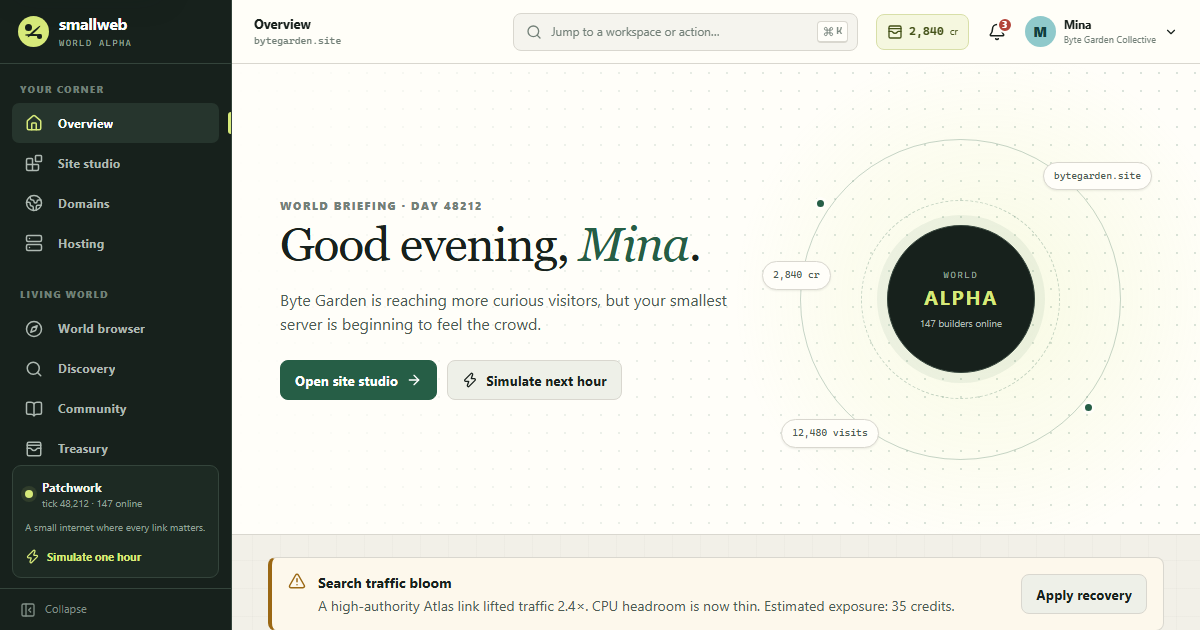
An internet small enough for one window
Smallweb is a local strategy-and-creation game whose world looks like a miniature internet. It begins with a seeded, single-player world that persists in the browser.
What you can do
Register simulated domains, configure DNS records, choose hosting, build sites from safe blocks, and publish releases. You can browse player sites, take part in the simulated community, advance the world clock, and use analytics to respond to traffic, costs, capacity, and incidents.
How it works
The prototype is a React and Vite application. Registry, ledger, publishing, search, and simulation work is kept in pure domain functions, while the complete world is stored in browser local storage. Simulation ticks use explicit seeded inputs instead of the host clock or Math.random(), so the same inputs produce the same result.
A deliberate boundary
Player sites are declarative data rather than arbitrary HTML, CSS, or JavaScript. A closed renderer handles the allowed blocks and internal navigation, keeping the prototype focused on operating its fictional internet rather than acting as a real hosting provider.